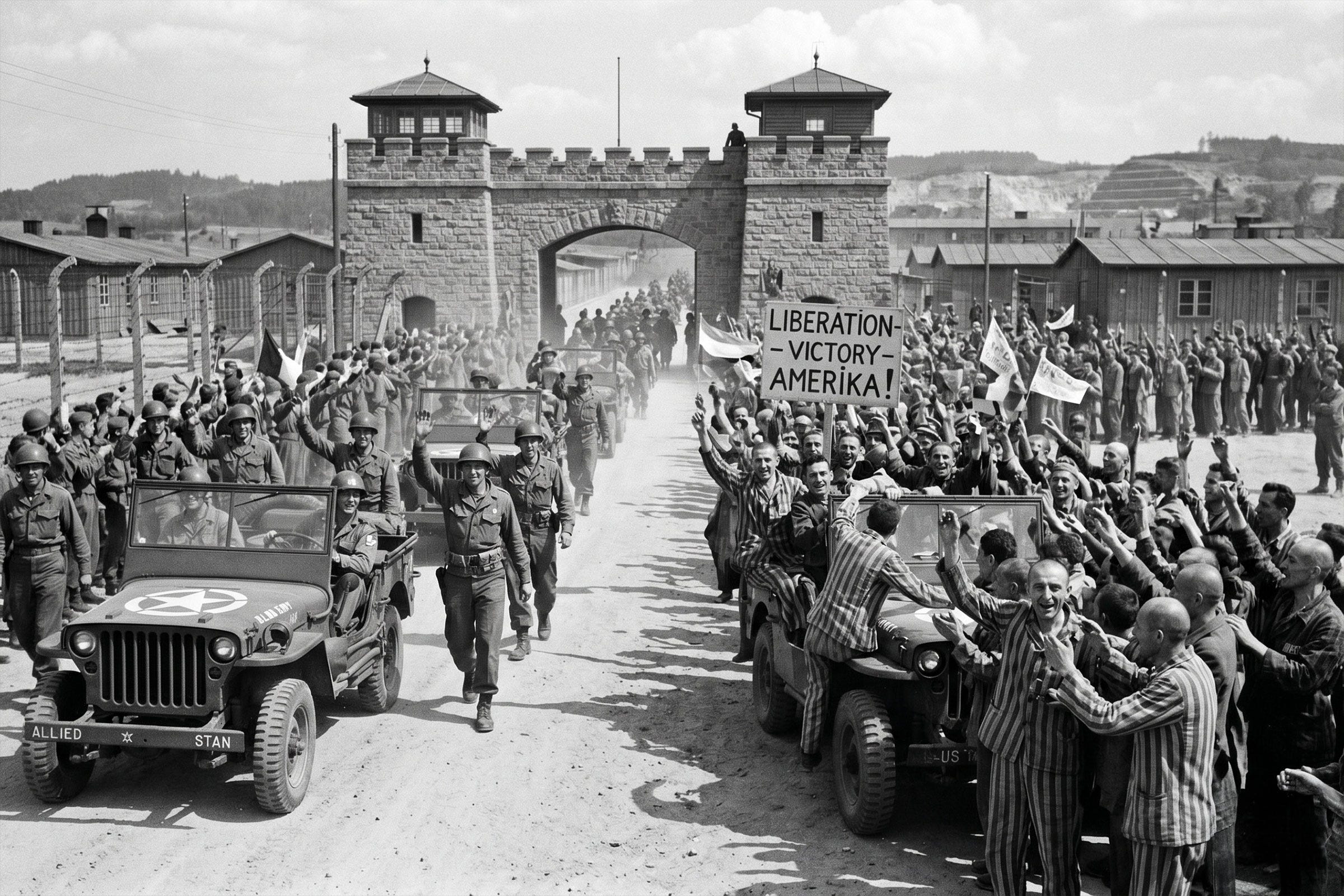
Mauthausen
The enemy says our captivity is tolerable, but Ecclesiastes tears away the lie and teaches us to long for liberation.
“Though now you do not see Him, yet believing, you rejoice with joy inexpressible and full of glory, receiving the end of your faith — the salvation of your souls” (1 Peter 1:8,9).
Mauthausen (MOWT-how-zen) is a small town in Upper Austria, only 20 kilometers east of Linz, where Adolf Hitler grew up. One of the Nazi concentration camps was located there. Unlike the death camps at places like Auschwitz, Mauthausen was a labor camp. People were not quickly killed; they were worked to death as Nazi slaves.
The Slaves of Mauthausen
When Hitler annexed Austria to the Third Reich in March 1938, the Austrian people embraced him with open arms, believing his lies. He was paraded through the streets and thronged by adoring multitudes. However, by the time the Allies liberated Austria in 1945, the nation’s eyes had been opened — 100,000 human beings had died at Mauthausen and other camps in Austria. The country had paid a cruel price for its acceptance of Hitler.
But think of the situation Austria was in between 1938 and 1945. The Austrian people lived in what we would call “enemy-occupied territory,” brutalized by a tyrant who had made slaves of them after promising greatness and glory. It was some time before they realized the mistake they had made when they welcomed Hitler so blindly, but once they saw what they had done, imagine their joy when reports began to circulate in 1945 that the Allied armies were coming to rescue them!
The gospel of Christ is also news of a coming liberation. First, it tells us about the mistake we made when we invited our worst enemy to be our ruler. But then it tells us that although we live right now in enemy-occupied territory, help is on the way. The Rightful King is coming back to crush the usurper and reclaim His kingdom. That is good news indeed — even better than when the inmates at Mauthausen were told they were going to be liberated.
Hope
Since the gospel is about liberation, it is a message of hope. To repeat, we are still living in enemy-occupied territory. The King has sent help to sustain us during the remainder of our captivity, but the gospel is mostly about a liberation that has not yet arrived. “The King is coming! He could arrive at any moment!” What a difference that hope makes. As long as we know that help is on the way, we can hang on. Until the King gets here, we can deal with whatever has to be endured.
But what does that have to do with Ecclesiastes? Well, the devil would like us to believe that we don’t have it all that bad right now. Knowing we’ve heard rumors of the King’s return, he wants to squelch our expectations. Like Hitler, he might say, “Your work in my camp is difficult, I know. But remember what I’ve told you: Arbeit macht frei (“Work makes you free”). God is a pessimist, always talking about the ‘vanity’ of life. Don’t listen to Him. Life here isn’t perfect, but it’s pretty good!”
Ecclesiastes strips the mask off the enemy’s face. It disabuses us of any notion that our lives in this world are enough to fill the emptiness in our hearts. And this is the news we must accept before the gospel can be heard as good news. As long as we’re content with what we’ve got, our longing to get out of this world will not be very great. We certainly won’t “groan” (2 Corinthians 5:1,2) to be released.
Contentment with this world is one of the greatest obstacles to the spread of the gospel. The gospel is little more than nonsense to an affluent, comfortable world. Remember the Austrians in the early days of the war? Still thinking that Hitler’s regime had produced prosperity, they would have laughed at reports that “liberation” was on the way. “We have no need to be liberated,” they would have said. “We’re doing fine.”
Unfortunately, Christians often think in a similar way. We turn the gospel into a message about happiness in the here-and-now. We agree with our secular neighbors about the importance of earthly happiness; we just differ on what is the best way to get that result.
To both the secular and the religious person, Ecclesiastes says, “Get over the notion that life in enemy-occupied territory is all right. It is not all right. It is vanity, and sooner or later it will break your heart.”
Had Solomon known what we know about God’s plan to create “a new heavens and a new earth” (2 Peter 3:13), he would certainly have agreed that eternity with God is the only ultimate answer to the problem that occupied him throughout his life: the distinctly unfulfilling nature of God’s blessings in this broken world.
Longing for Liberation
So let me say it again: the King is coming back. Liberation is on its way.
“In My Father’s house are many mansions; if it were not so, I would have told you. I go to prepare a place for you. And if I go and prepare a place for you, I will come again and receive you to Myself; that where I am, there you may be also” (John 14:2,3).
“Blessed be the God and Father of our Lord Jesus Christ, who according to His abundant mercy has begotten us again to a living hope through the resurrection of Jesus Christ from the dead, to an inheritance incorruptible and undefiled and that does not fade away, reserved in heaven for you, who are kept by the power of God through faith for salvation ready to be revealed in the last time. In this you greatly rejoice, though now for a little while, if need be, you have been grieved by various trials, that the genuineness of your faith, being much more precious than gold that perishes, though it is tested by fire, may be found to praise, honor, and glory at the revelation of Jesus Christ, whom having not seen you love. Though now you do not see Him, yet believing, you rejoice with joy inexpressible and full of glory, receiving the end of your faith—the salvation of your souls” (1 Peter 1:3-9).
If you think, as a Christian, that you’ve already been liberated, Ecclesiastes can adjust your attitude about that. But you’ll have to dispense with the idea that Solomon’s negative report on this world is only “how life is for people who don’t have God in their lives.” Solomon’s report is a description of what this world is like — for everyone (Romans 8:20-22). And no one needs to hear this any more than Christians who have settled down so comfortably in the “Austria” of this present world that they hope the liberating armies won’t show up and spoil the party.
The wonderful thing about the gospel is not exemption right now from the futility of life “under the sun,” but the promise that “the Sun of Righteousness” (Malachi 4:2) is coming back to finish what He began when He invaded Planet Earth two thousand years ago.
When He left to return to heaven (John 14:2,3), two angels said to His disciples, “Men of Galilee, why do you stand gazing up into heaven? This same Jesus, who was taken up from you into heaven, will so come in like manner as you saw Him go into heaven” (Acts 1:11).
He is coming back! Help is on the way! If you listen to Ecclesiastes, you will cease being so fond of your captivity and begin longing for your liberation.
Arbeit Macht Frei
They told us work would make us free
and we believed it, building walls
around the only life we’d known,
mistaking the wire for a horizon.
Twenty kilometers from where the lie was born,
a town learned what the lie was worth:
a hundred thousand names
folded into Austrian earth.
But Solomon had seen the camp before there was a camp —
walked every corridor “under the sun”
and found them all the same gray length,
and called it, plainly, vanity.
Not despair. A diagnosis.
The wound named so it might be tended.
Because the King who left by cloud
said He is coming back the same way He went,
and until the trucks roll in
and the gate swings wide
and someone finally says it’s over —
we are not free. We are waiting.
Let the waiting ache.
Let the ache become a longing.
Let the longing keep us
from calling the camp a home.
Gary Henry - WordPoints.com


